Showing posts with label Interview. Show all posts

Sunday, 16 February 2014

INTERVIEW: Farao

*Originally published for The Line of Best Fit (13/2/14)

Girl + guitar? Yeah, we’ve heard it all before. But you haven’t, not quite the way Norwegian singer-songwriter Kari Jahnsen, aka Farao, writes music. As if thumbing through ancient tomes, this newcomer has quietly mastered the basics of great, emotional songwriting whilst allowing her affection for contemporary music to pervade; a beautiful conflict of old and new. That is, of course, if her wonderful debut EP Farao is anything to go by.

But it’s not just an acoustic guitar at the helm of Farao’s music. She plays almost every instrument under the sun in an array of other bands, from drums in London/Brighton lo-fi lot Hella Better Dancer, to bass in Norway-via-London’s Anna Lena & The Orchids. Perhaps this vast knowledge and experience with music, the wealth of which belies her age, is what makes her alternative brand of folk-pop so rich, so crisp, so compelling.

Now based in London after relocating from Norway, those chilly landscapes never sound too far away from Farao’s cutting melodies and deeply moving lyrics, aided no less than by Iceland serving as the backdrop for the recording of her aforementioned EP. Like the enthusiasm embroiled in learning new instruments (viola is next on the agenda), Miss Jahnsen will literally move shores for her music.

We try to decipher where this drive comes from, learning that being bred isolation can be more a blessing than a curse, and that Radiohead are her true inspiration.

What was it like growing up in Norway? 

Norway is a sheltered place to grow up, and I had a very good and stable childhood there. I grew up in a small place called Valdres where there aren’t that many opportunities, specifically within the arts. I could really notice that in a negative way when I moved away at the age of 19 and had never been in a band before. Although I love where I’m from, I’m much better suited in a city. I become very restless if I don’t have something to do and people to meet and gigs to attend all the time.

When did your affair with music begin? 

I started really caring about music in my early teens. I went to as many music festivals as I possibly could every summer, and often drove with my friends to Oslo (3 hour drive from my home town) to go to gigs, and drive back in the night in time for school the next day.

What music did you grow up listening to and what do you like now? 

It all started out with punk/rock and grunge for me. Dave Grohl was my Justin Bieber, and early Foo Fighters and Nirvana was a big thing in my life. After my rebellious punk rock period I discovered Sigur Rós and Radiohead, and that’s when I knew I wanted to become a musician. Right now I listen to stuff like Warpaint, Poliça, Wild Beasts, Emilie Nicolas, James Blake, Atoms For Peace, Angelica’s Elegy and Samaris.

How many instruments do you play and how did you learn them? 

Hard to say…I play guitar obviously, started when I was around 17. I have been singing all my life. I started playing drums after college, when a friend asked me to join her band. I said yes, not knowing how to play drums but figured it out eventually. I play bass in my band mate’s solo project, Anna Lena & The Orchids. I am trying to learn the viola too; it no longer sounds like a dying cat when I play it, but I am definitely not good. I can also make it sound like I know how to play piano to someone who doesn't know how to play piano.

Where do the drone sounds that feature so heavily on Farao come from?

I used an old synth, a Russian beauty called Elektronika EM-25. It’s pretty awesome. I combined that with my Casiotone MT-65. Those two together are a big part of the sound on the EP.


You moved from Norway to London, England. Does landscape have much of a part to play in your writing? 

Not intentionally, but I think the wild and dramatic landscape of where I'm from has definitely influenced the Nordic sound and that, in turn, has shaped the music I make. London is pretty much the exact opposite and that contrast is inspiring.

Do you write from experience or just from what you read/hear about relationships, life etc.? 

I write mostly from my own experience. I write about any kind of relationship I have with other people, be it professional, friendly or romantic. I enjoy putting myself in their shoes and writing a song from the other person’s perspective, so I am kind of singing back at myself. It makes me view myself from outside.

How did playing drums for Hella Better Dancer come about? 

I met them when I did a gig in Cambridge a year and a half ago, we were on the same bill and ended up getting the train back to London together. I love playing with them, but unfortunately there’s less and less time for that now that Farao is kicking off.

What do you want to achieve with your music? 

When I hear a truly amazing song, I think to myself that that song must have always existed somewhere. It seems impossible to me that songs like “Paranoid Android ” at one point didn't exist. I want to work as I hard as I can to write a song like that, where my listeners would not be able to imagine ever having been without it.

Why is music so important to you?

I write music to express myself, and process my thoughts and emotions. The best way to get something out of my head is to put it in a song and leave it there, so I can move on.

Future plans? 

Record my debut album in February, tour in the spring and play as many festivals as I possibly can in the summer!

Farao’s self-titled debut EP is due for release on 10 February via Something Nothing Records. She headlines The Waiting Room, London on 25 February.

Saturday, 15 February 2014

INTERVIEW: Febueder

*Originally published for The Line of Best Fit (5/2/14)

Ascot trio Febueder couldn't better defy expectations. All aged 18, the boys may fill their time with skateboarding and music, but there’s none of the slacker rock so synonymous with that lifestyle present in their writing.

No, there’s something far more precocious about Febueder’s sound, like the trio – Kieran Godfrey (vocals/guitar), Harry Summersgill (bass), Samuel Keysell (drums, sample pad) – have old heads on young shoulders. And the biggest curveball of all? Their challenging, eccentric music couldn’t sound further away from the Home county they live in.

November’s Soap Carve EP was experimentation at its most joyous: vast, stirring and playful, devoid of big stumbling blocks. Though composed on a simple bed of guitar, bass, drums (and the odd sample), the trio somehow made a parcel of intricate sounds, wringing each component out over Alt-J-esque vocal lines. The EP struck that rare and beautiful balance between leftfield music and pop, deservedly praised by critics and radio DJs.

We had a chat with the band to see what this new attention has brought, discovering in the meantime their love Canadian music and gangster noire 80′s swing. Oh, and Ascot doesn’t have a music scene.

How do you feel about the response to your music so far? 

We feel chuffed from what responses we get. It definitely makes us feel comfortable with what we are doing.

What’s it like to be compared to bands like Alt-J and Animal Collective? 
Both of the bands are extremely different, especially when compared to each other. It’s a nice comparison that we take from that. It’s kind of like an intelligence meets a madness. We like that “two opposite ends of the spectrum meeting in the middle idea”. It’s a heart-warming sentiment.

How would you describe your hard-to-pigeonhole sound? 

We believe an onset description is that we are experimental, playful and connective to the listener.

Tell us about Febeuder’s beginnings? 

It began without our own awareness. Songs were being made spontaneously. The three of us played our own instruments and it then bloomed into our own roles within the music. It was an instinct to try something new, exciting, something we didn’t really know much about.

How did you come up with the name? Does it mean something? 

The name, Febueder – it is this completely made up thing/creation. We want the songs to form meaning and for the name of the band not to interfere with these meanings.

You guys all live in Ascot. What’s the music scene like there?

Ascot doesn’t have a music scene. There’s a jazz orientated venue, but that’s it.

“Alligator” is the first track we heard from you. What’s it about and when did you write it? 

Alligator was written about communication with one another and falling into something magical, or of bad fortune. It’s about learning and reading from each others’ lives. It was written in December 2012 (that seems like quite some time ago) and we recorded it around February last year.


What are your musical and/or artistic inspirations? 

Musically we are inspired by a wide range of artists, such as Graham Van Pelt (Miracle Fortress/Think About Life), Zach Condon (Beirut), Sandro Perri, Dan Snaith (Caribou) (to mention a few). At the moment with our next EP, which we are currently recording, our inspiration is that of a slow grooving gangster noire 80′s swing, with a jungle of the city at the heart.

What does writing and performing music mean to you? What do you want to get out of it? 

Writing and performing is internally rewarding. It means that we are more than satisfied with what we are doing. To do this for a living is what forms the motivation. To be able to have the freedom of time to create and perform music is what we’re doing this for.

Future plans? 

In the near future we are eager to finish recording and release a second EP. An album is also in our minds to follow. We’re working to blossom more.

Soap Carve EP is out now on Tape Club Records.

Friday, 31 January 2014

INTERVIEW: Warpaint


*Originally published for The Line of Best Fit (17/1/14)

“We want our music to be universal, something people can be in the mood for at any point in time”. 

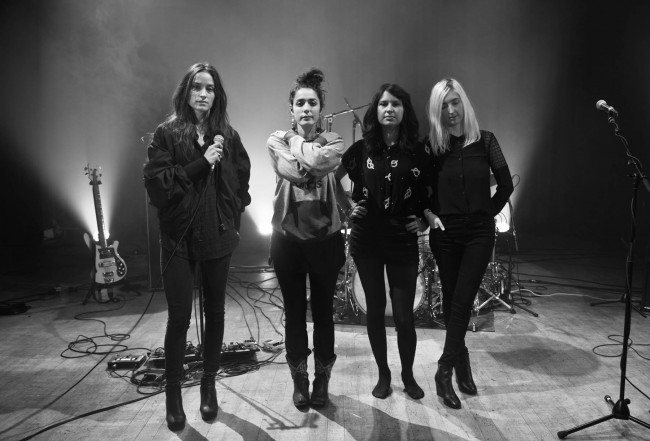
A personal, spiritual connection to a piece of music is a difficult bond to break. A shared one is something else. For the hundreds piled into Brixton’s O2 Academy in October, many were reminded of Warpaint’s effortless ability to spark numinosity, stimulated by their brand of dark, atmospheric music. The LA quartet’s writing has always been about creating a mood – albeit an indefinable one – but one that swallows you whole and makes you feel connected to anyone else similarly wired into their music. The air floating amongst Brixton’s high ceilings that autumn night hung heavy with an unusual, spiritual feeling of shared emotion.

“That was a really big moment for us”, says Warpaint bassist/vocalist Jenny Lee Lindberg down the phone. “We were excited to play our new songs and I was so shocked by the reaction. I felt a strange sense of comfort which was the opposite of what I expected.”

Though the nature of the band’s signature erratic sound can be unnerving, Warpaint’s songs are frequently comforted by walls of warm ambience, the latter thread that bound their 2010 debut, The Fool, so well together. Of course, this unity between songs has the potential to soothe many a heart and ear, perhaps a “universal” sound Lindberg so desires. ”If [our music] evokes any kind of emotion that people enjoy, then I’m happy”, she says.

But Warpaint’s beautifully perplexing musical dichotomy of repulsion and attraction will always lend itself to healthy discussion. The nub of everything, actually, is: what is it that makes them so special? Perhaps it’s their own worldly-wise understanding of who they are, how they sound and how they work together as a group. As Lindberg explains, it’s not like they care too much about what people think.

“I do not read reviews, there’s nothing you can do change what you’ve done. I don’t want to care, though obviously I do a bit, because I’m human. But really we just want to make our art.” Indeed, Warpaint just want to get on with it.


This strength of conviction can in part be attributed to the band’s longevity in the face of adversity. Formed in LA in 2004 after Lindberg’s sister, actress/drummer Shannon Sossamon, invited childhood friends Emily Kokal (guitarist/vocalist) and Theresa Wayman (guitarist/vocalist) to start a new band, it took just a few line-up jumps to delay their first album by half a decade. After various drummer changes following Sossamon’s departure for her acting career, the stars at last aligned when Australian drummer Stella Mozgawa stepped-in for The Fool in 2009.

These ambitions, meetings and uprootings to LA were a blessing, particularly for Lindberg who had left home in Nevada with little idea of what to do next.

“I was 19 when I moved to LA. My sister was modelling and acting there and then I did a bit of modelling too. I just dabbled. I had a lot of energy when I was growing up – I had ADD. My mom would say ‘try something new’ and I would and most things just did not resonate with me. I’d never thought about playing bass before.

“I definitely listened to music by myself a lot, though. I’d sit in my room, write my journal and listen to bands like The Cure, Smashing Pumpkins, Depeche Mode, Nine Inch Nails and Kate Bush.”

Just before The Fool came out, the girls worked in cafes or on artistic projects. Lindberg worked at a vegan cafe and as a vintage clothes buyer/maker. Kokal worked in cafes and babysat. Theresa made and sold raw chocolate, as well as helping her boyfriend with his clothing designs.

Since their debut release (produced by John Frusciante, who was dating Kokal at the time), Warpaint have become the cream of the critics’ crop, thanks to their inventive songwriting and mesmerising live shows. In March 2012, they paired-up with celebrated producer Flood and long-term Radiohead producer Nigel Godrich, swapped the city for the stunning landscapes of California’s Joshua Tree and recorded Warpaint in a month. Never has the band’s confidence and empathy been more apparent than on their long-awaited follow-up.

“The biggest difference between this album and the last is the simplicity of the music and everyone integrating with each other”, Lindberg says. “For the first time we actually have songs within the record that were written by one person.”

There are certainly changes: from instrument-hopping (Lindberg clarifies that it’s her who plays the guitar on “Feeling Alright”, with Wayman on bass), to each member having a much more assertive role. To name but a few examples: Mozgawa penned “Feeling Alright” and “Go In”, Lindberg wrote “CC” and “Son” is Wayman’s baby, completed by Mozgawa’s drum composition.

“It can be tough being in a band with your best friends”, Jenny adds. “It takes work and it needs nurturing and it needs love, kindness and compassion. Doing your favourite thing with some of your favourite people in the world is amazing, but mixing business with pleasure can also get pretty heady. The most important thing is compassion.”

That understanding of each other’s individual creativity is what allows the band to remain open to new ideas, which is more so the case than ever on Warpaint.

On the menu this time round is trippy lounge (“Hi”), dreamy synthpop (“Biggy”), piano balladry (“Son”) and even some off-the-wall alt hip-hop (“Disco//Very”). Guitars are less the bedrock, the songs are more wholesome and vocals loom larger at the fore. However, amid what sounds like a big change, isn’t a big change. Somehow, just somehow, the record carries all the band’s original juxtapositions: their mismatched coherence, their knack for pulling you in and spitting you out. Ultimately it’s the stuff that makes Warpaint, well, Warpaint.


“I think it’s a sexier record and has more groove. The grooves are more meditative and transient than on The Fool. The (writing/recording) period was really easy and pretty fluid, moving at a faster pace than The Fool which took us a couple more years. This time we had been touring for two or three years, so when we were on the road I did a little bit of writing. We were all ready to write and play new stuff. I remember there was a new line that Emily would play over and over on tour, the one for “Keep It Healthy”. That kept going around and we would get all excited and groove around to it.”

When the time felt right to record, the band “wrote every day” in a Geodesic dome in the California desert. Their creative movements were filmed by Lindberg’s husband and British visionary director, Chris Cunningham, who started popping his head in after working on other projects nearby. The result is Love Is To Die, to be released later this year.

Lindberg adds: “It never felt like we were being filmed, it was really organic. (Chris) wasn’t in our face and, you know, when the sun went down, the pot came out…it was fun.”

The new year now sees the band releasing the record, trying to “perfect” their live show and utilising the down time they have in between schedules. “I just want to keep gathering content all the time, keep on top of writing”, Lindberg concludes.

And so while we’re still trying to get to the heart of what makes the four-piece so unique, it seems Warpaint have got themselves all sussed-out. Musically and individually, they are free, unbounded, if only to bind listeners together through art. But as a group, they are firmly rooted, if only by their immovable friendship. The whole is greater than the sum of its parts.

Warpaint is out now on Rough Trade.

[Photography by India Whiley-Morton].